
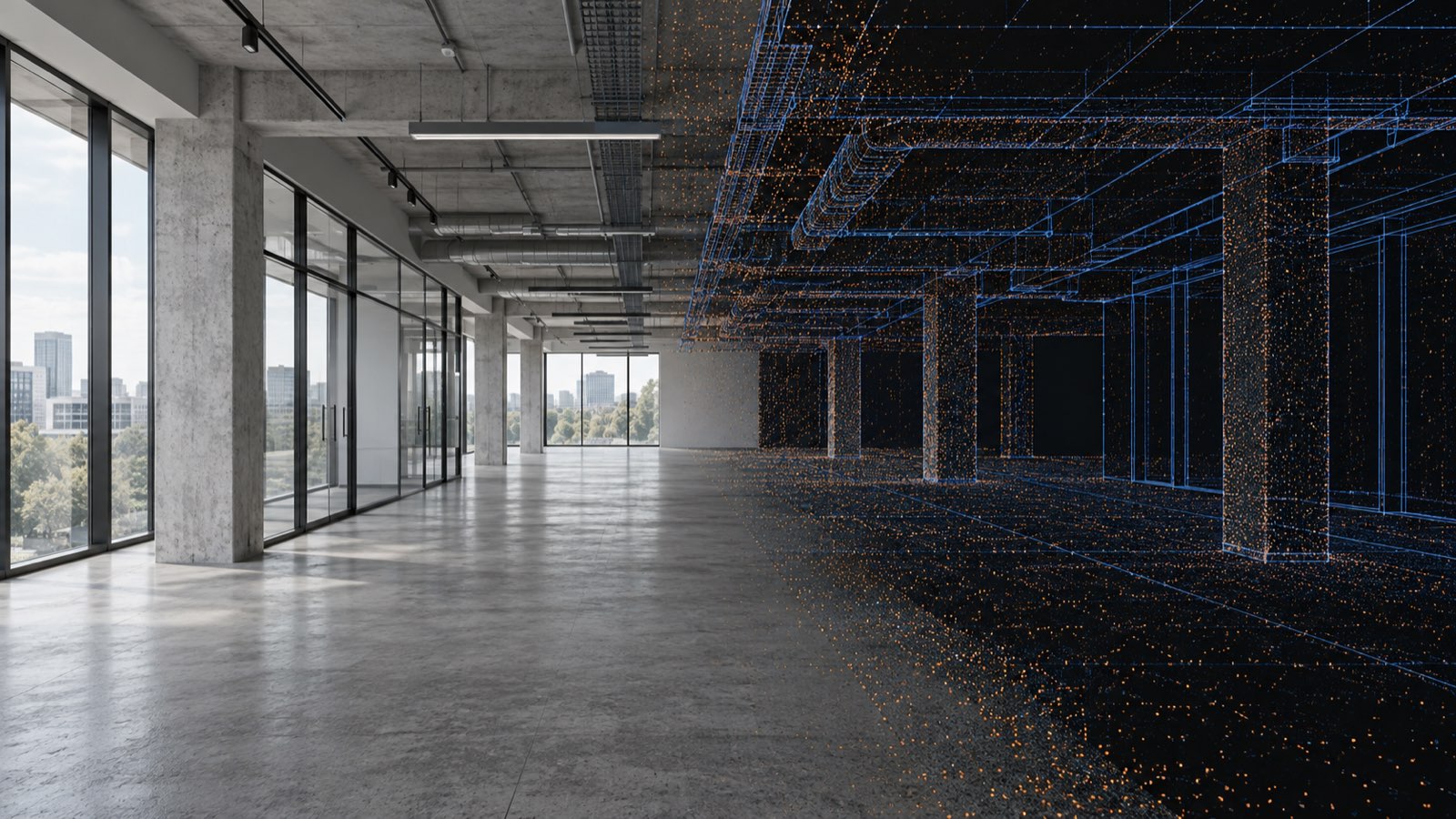
A digital twin is a measured digital record of a building that you can open, walk through, and measure without going to the site. Everything else attached to the term, like live sensor feeds, predictive maintenance, and energy modeling, extends that record rather than replacing it.
If you’re the one who has to justify the spend internally, here’s what you’re actually buying.
What the capture produces
Most commercial buildings already have imagery. What they usually lack is a reliable measurement.
A digital twin starts with capture. Your space gets documented at fixed positions, in high resolution, so the geometry stays consistent from room to room and floor to floor. You end up with a photoreal, walkable 3D tour plus measured floorplans you can pull dimensions from.
The numbers matter more than the label:
- 134MP panoramas and 4K imagery, so the detail survives when someone zooms in on a panel, a window frame, or a finish
- About 1% dimensional accuracy, so a measurement taken from the model is one you can act on
- A shareable link, so a broker, an engineer, and an adjuster can all look at the same building without three separate site visits
- A full year of hosting, so the record is still live the next time someone has a question about the building
If your team needs that record inside their own software, E57 and OBJ point clouds, CAD, and BIM deliverables are available as add-ons or as separate services. Dimensions certified for construction documents come from our as-built and scan-to-BIM work rather than from an export off the tour, so ask for the one the job actually calls for.
What you’re buying is a Matterport virtual tour delivered as documentation instead of marketing material.
What a digital twin is not
Three distinctions worth making, because the confusion costs people money.
It isn’t a marketing photo shoot. A listing photo set makes a space look good. It won’t tell an HVAC contractor where the units sit or give a facilities team a measured floorplan to work from. Documentation-grade capture is the one that survives a lease negotiation or an insurance question.
It isn’t a live monitoring system. Unless someone has attached sensors to the building, a twin won’t stream temperature, occupancy, or equipment status. It gives you the accurate spatial record that a monitoring layer sits on top of.
It isn’t a substitute for a licensed professional’s judgment. A twin tells you what’s there and how big it is. It won’t tell you whether the building meets code.
Where the record gets used
Existing conditions documentation is where most commercial buyers see the return first. Instead of sending three people out with tape measures and clipboards, you capture the building once and everyone downstream works from the same record.
That pattern repeats across the industry.
Brokers and landlords answer tenant and buyer questions from a walkable tour and a measured floorplan instead of booking another showing, which matters most when the building is occupied and access is tight.
Architecture and engineering firms start renovation and retrofit work from the building as it stands, not from a drawing set that stopped matching it years ago.
Developers and general contractors document a site before work starts, so change orders and scope disputes come down to comparing against a record instead of arguing.
Facilities and property management teams get an as-built floorplan that matches the building today, rather than the one drawn seven years ago.
Insurance adjusters work from a navigable, timestamped record of conditions, pre-loss or post-loss, and close the gap between a claim and a decision.
How the capture runs
A Matterport Pro2 or Pro3 gets positioned at fixed stations through the space, and the system stitches the scans into one continuous model. We plan the visit around how your building runs, after hours for retail or around tenants for occupied space, so a scan never means shutting anything down. You’ll know who’s on site and when.
Most single properties are captured in one visit. Turnaround depends on square footage and access rather than on a rotating crew’s calendar. One team shows up, captures the property, and delivers the tour and the floorplans.
The hand-off problem
The reason people hesitate on a digital twin usually has nothing to do with the technology.
The industry has trained buyers to expect a call center that takes the order, a rotating crew that shows up, and a file that arrives from someone who was never on site. When something’s wrong with the deliverable, nobody owns it.
We run it the other way. No account managers and no hand-offs, so the person you speak to before the scan is the person accountable for what comes back. We’re a small team that’s captured 20M+ sq ft across 23 states and 19 countries over seven years, with FAA Part 107 certification for aerial work where the property needs it.
How to justify it internally
If you need to make the case to someone holding the budget, drop the term “digital twin” and describe the deliverable.
Tell them: we can produce a measured, photoreal 3D record of the building, accurate to about 1%, with a shareable link and floorplans, hosted for a year. Site access arranged around the tenants. One point of contact start to finish.
Then tie it to a cost you already carry. Repeat site visits, resurvey work when the drawings don’t match the building, or the hours your team spends answering questions a tour link would answer in thirty seconds.
Where to start
Pick one building. The one that generates the most repeat questions, or the one you’d least like to survey again by hand. Document that one properly, then look at the accuracy, the turnaround, and who you had to talk to along the way.